The Network Decides How Everything Else Performs
Once voice, ERP, file storage, and security all run through the same pipe, the network stops being a utility line item and starts being the thing that determines whether the business runs smoothly or fights itself. The trap is that carrier availability is wildly uneven building to building — the provider with the best price at one address may not serve the address two miles away, and the one that does may quote a 90-day build. Executive Technologies checks serviceability across the full carrier set at every one of your addresses, then designs the architecture around what is actually available, what your applications need, and what you are willing to spend.
- Fiber, ethernet, dedicated internet
- SD-WAN, SDN, VNS
- MPLS where it still fits
- Broadband, fixed wireless, 4G/5G
- Business continuity & failover
- Direct cloud interconnect
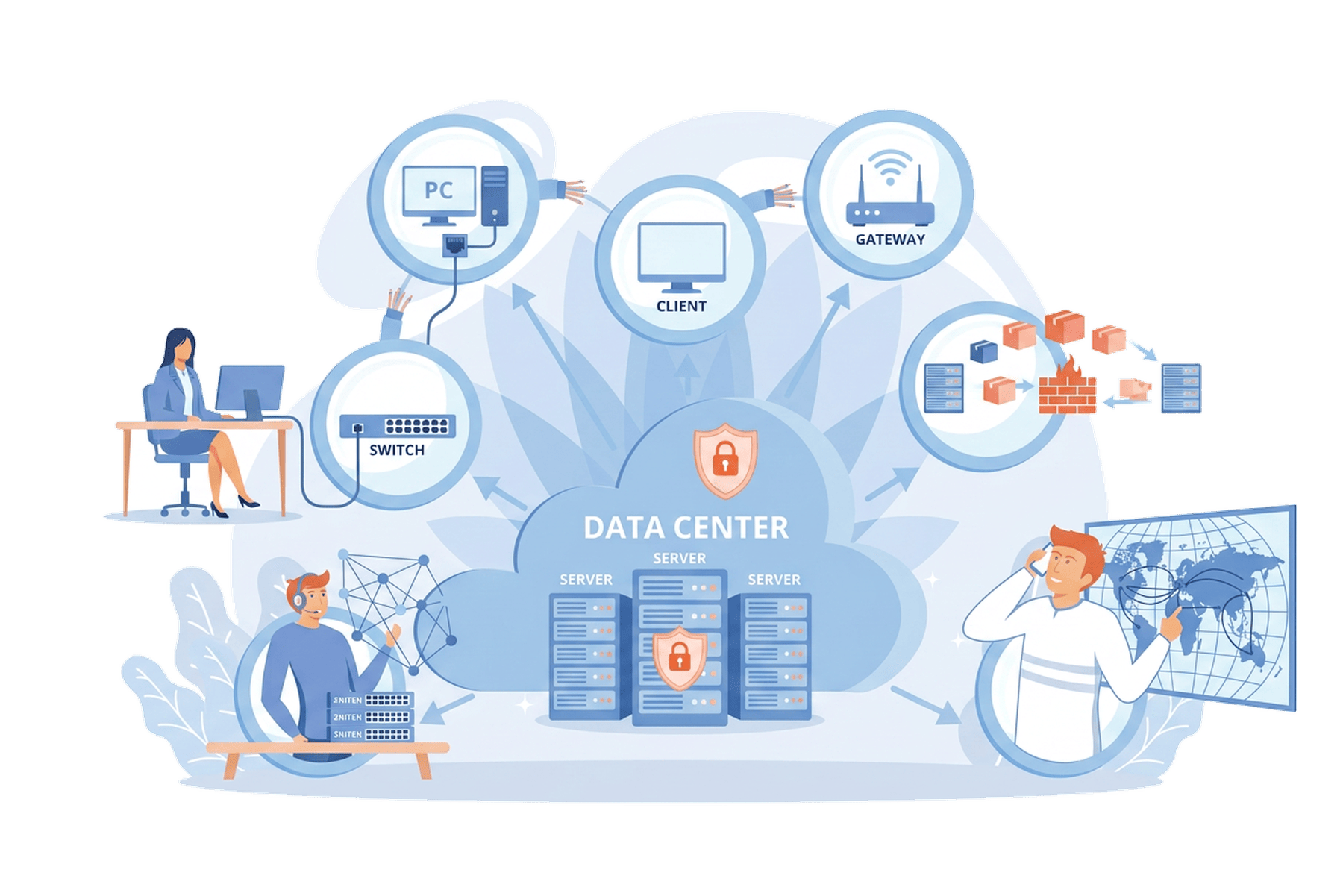
How We Design and Source a Network
Circuit pricing is not published, availability changes block by block, and no single carrier will tell you when a competitor serves you better. This is how we get past that.
Requirements & Sites
Every address, what runs at each one, real bandwidth consumption versus what you are paying for, uptime tolerance, and which locations genuinely need diversity rather than just wanting it.
Serviceability Check
We run every address against the full carrier set — including regional fiber providers most businesses never hear from — to find who can actually deliver, at what speed, and how long the build takes.
Architecture & Pricing
Design the topology, then take it to market. You get competing quotes normalized to the same scope, with install intervals, term options, and SLA credits shown side by side.
Install & Ongoing Support
We manage orders, build intervals, and turn-up across multiple carriers, then stay on as the escalation path when a circuit goes down and the support line is not moving.
What We Source
From a single-site internet upgrade to a multi-state SD-WAN refresh, sourced across the full carrier and provider market.
Dedicated Internet Access
Symmetrical, SLA-backed fiber and ethernet with committed bandwidth and real repair commitments — the difference that matters when voice and cloud applications run over the same connection.
SD-WAN
Application-aware routing across multiple circuits, centralized policy, and sub-second failover. Frequently pays for itself by letting cheaper broadband carry traffic that used to need premium bandwidth.
Broadband, Fixed Wireless & 5G
Cost-effective secondary paths, fast-turnup connectivity for new locations, and wireless backup that keeps a site running when the fiber is cut.
MPLS Where It Still Fits
It is not dead everywhere. Some traffic profiles and some site mixes still justify it, and we will say so rather than pushing a rip-and-replace that does not pencil out.
Continuity & Failover
Diverse-path design, automatic failover, and honest answers about which sites need it — because paying for diversity that shares the same conduit is a common and expensive mistake.
Cloud Interconnect
Direct private connections into AWS, Azure, and Google Cloud for predictable performance on workloads where the public internet is not good enough.
Common Questions
What is the difference between dedicated internet and business broadband?
Dedicated internet gives you a committed, symmetrical amount of bandwidth with a service level agreement and a contractual repair window. Broadband is shared and best-effort, with upload speeds usually a fraction of download. Broadband is fine for a lot of uses and a good secondary path. It is a poor primary connection for a business running voice, a contact center, or cloud-hosted core applications.
Do we need SD-WAN?
If you have one location and one circuit, probably not. It starts earning its cost at three or more sites, or anywhere you want to combine an inexpensive secondary circuit with a primary and have traffic move between them automatically. The savings usually come from what it lets you stop buying, not from the product itself.
How long does a fiber install take?
If the building is already lit, thirty to forty-five days is typical. If construction is required it can run 90 to 180 days or longer depending on permits and how far the fiber has to come. We surface build intervals in the quote stage so nobody signs expecting a date that was never realistic.
Our carrier says we are the only option at our address.
That is often what they believe, because they only check their own network. Regional and wholesale fiber providers serve far more buildings than most businesses realize. Checking costs you nothing and it is one of the more common places we find real money.
Can you help with an existing circuit that keeps going down?
Yes. Chronic circuit problems and unmoving trouble tickets are a normal reason to call. We can escalate on your behalf, and if the answer turns out to be a different carrier we will source that instead.
Find Out What Is Actually Available at Your Buildings
Send us your addresses and a current bill. We will come back with what every serving carrier can deliver, at what price, on what timeline — including the ones nobody has told you about.
Book a CallGet Competing Quotes
Tell us what you're running and we'll bring competing bids from 100+ providers — at no cost to you.
No cost, no obligation. Executive Technologies is paid by the provider you select.